
Plans rarely survive contact with the disaster. After thirty years in this work, I’ve learned that the binder on the shelf isn’t what carries you through the worst day, but frameworks, judgment, and the people in the room are. This essay is about why frameworks matter more than plans, and what experienced leaders actually fall back on when conditions stop matching the assumptions.
This is the first article in Ground Truth, a five-part series from Jim Featherstone.
Why Frameworks Matter More Than Plans in Crisis Management
After more than thirty years in crisis and emergency management, I’ve helped develop a lot of plans, from the 2000 Democratic National Convention to the debris removal mission following the January 2025 Palisades Fire.
Over time, those experiences taught me something important.
Disasters rarely follow the plan.
Former FEMA Administrator Craig Fugate summarized this reality in a phrase now widely repeated in emergency management:
“The disaster gets a vote.”
Your plan doesn’t get to decide how the event unfolds.
The event does.
The wind shifts.
The fire jumps the line.
The evacuation route you expected to use is already gridlocked.
And suddenly, the binder on the shelf isn’t driving the response anymore.
People are making decisions in real time.
When conditions start changing quickly, leaders fall back on something else — experience, judgment, and whatever real-time information they can gather.
That doesn’t mean planning is useless.
Far from it.
The planning process brings the right people into the room. It exposes gaps in thinking. It builds the relationships that become critical when the incident actually happens.
But plans have an unavoidable limitation.
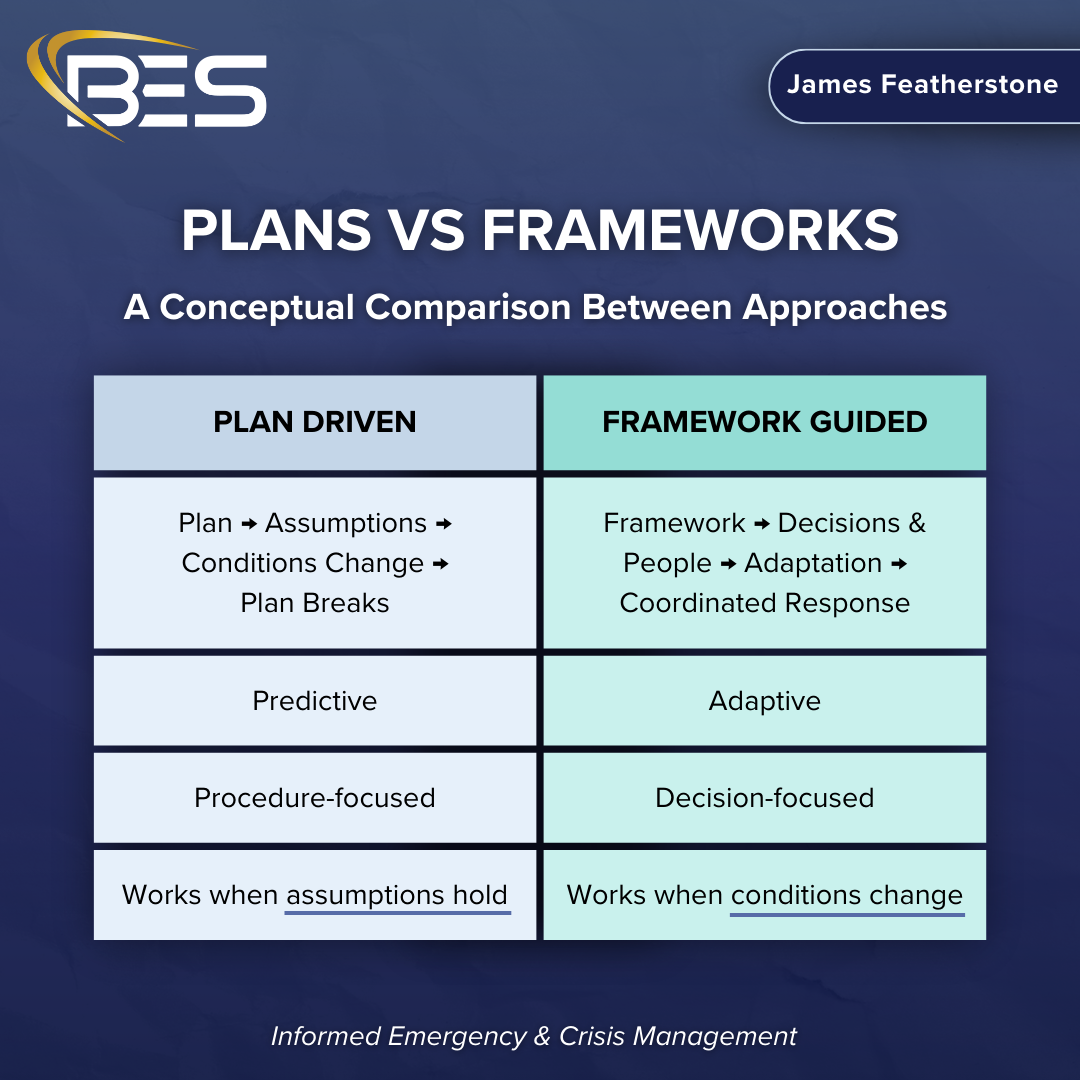
They are built on assumptions.
They assume the hazard behaves roughly the way it was modeled.
They assume infrastructure holds.
They assume resources arrive when expected.
Disasters are famous for violating assumptions.
Which is why I sometimes compare traditional emergency plans to the Maginot Line.
Before World War II, France constructed an elaborate defensive system designed to stop a German invasion. It was one of the most sophisticated military engineering projects in the world.
Germany simply went around it through Belgium and the Ardennes in 1940.
The Maginot Line wasn’t poorly built.
It was brilliantly built for the wrong scenario.
A lot of emergency plans have the same problem.
They’re designed to solve the last disaster, while the next one takes a completely different route.
Many plans become more documentary than operational. When events diverge from the assumptions those plans were built on, responders often find themselves improvising in real time.
And that’s exactly what tends to happen in real incidents.
The plan stops providing answers.
People start making decisions.
How Decisions Actually Happen During a Crisis
There’s another reason rigid plans often struggle during real incidents.
It has to do with how experienced leaders make decisions under pressure.
Psychologist Gary Klein studied fireground commanders and discovered that they rarely pause during a fast-moving incident to compare multiple options in a formal decision process.
Instead, they recognize patterns from experience, identify a workable course of action, and mentally test whether it will hold.
Will this work here?
What happens next?
What would make this fail?
If the answer holds up, they move.
Klein described this process as Recognition-Primed Decision Making.
It isn’t improvisation in the casual sense.
It’s experience operating inside a framework.
Frameworks provide the structure that allows people to adapt when conditions change faster than the plan.
The Third Variable: People
Frameworks and decision models explain a lot about how crises unfold.
But there’s another variable that matters just as much.
People.
Retired General Stanley McChrystal talks about this in his leadership reflections on modern operations.
As environments become more complex and distributed, leaders can no longer see everything happening in real time.
The job of leadership shifts.
It’s no longer about controlling every decision.
It’s about creating shared understanding among the people making those decisions.
Disaster response works the same way.
No single leader sees the entire situation.
No single plan anticipates every development.
And no jurisdiction manages a crisis alone.
What matters is whether the people involved share enough understanding and trust to adapt together.
Frameworks help create that structure.
Relationships make it work.
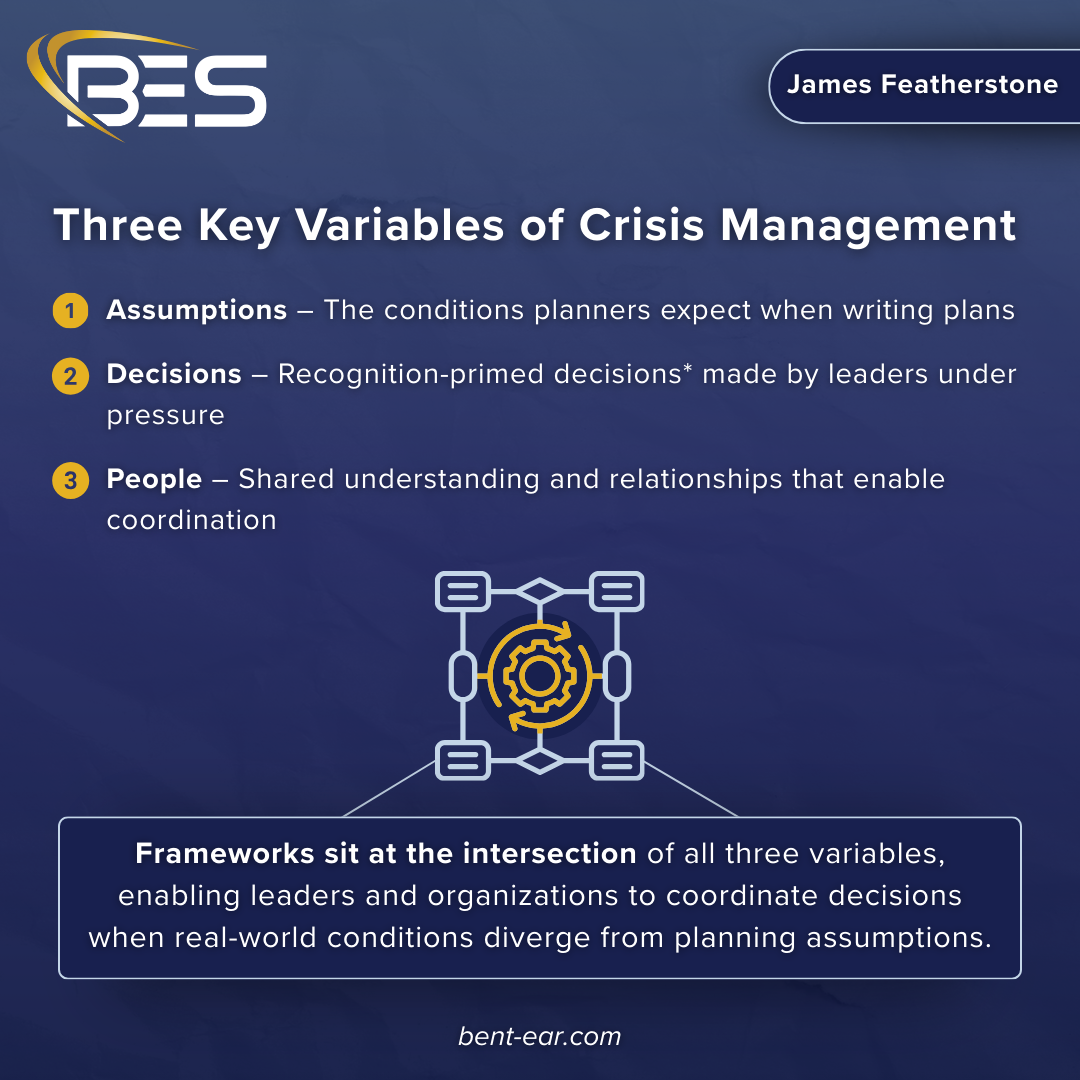
In practice, crisis management sits at the intersection of three variables: assumptions, decisions, and people.
Plans are built on assumptions.
Leaders make decisions in real time.
And people — across agencies, jurisdictions, and disciplines — must coordinate those decisions under pressure.
Frameworks provide the structure that allows those three elements to work together.
ICS: A Real-World Framework
Ironically, one of the best examples of this idea is something many responders initially experienced as rigid.
The Incident Command System.
When ICS expanded nationwide in the early 2000s under the National Incident Management System, it was often taught through the lens of large wildland fire incidents, where operations unfold over days, and organizational structures grow deliberately over operational periods.
Municipal responders operate in a very different tempo.
A structure fire unfolds in minutes, not days. Command decisions happen in seconds.
For many responders, early ICS training felt rigid because it didn’t reflect the speed of their environment.
But that was never the intent.
ICS was designed as a framework, not a script.
The structure remains consistent.
The application adapts to the tempo of the incident.
The Real Value of Frameworks
Plans attempt to anticipate the crisis. Frameworks prepare people to manage it.
They provide shared principles, priorities, and coordination mechanisms that allow leaders to adapt when the unexpected occurs.
And in complex incidents, that matters.
Because crises are ultimately managed by people — not documents.
One Question for Emergency Managers
Pull out your most important emergency plan this week.
Look at the assumptions it depends on.
Then ask one question:
What do we do if this assumption is wrong?
If you can’t answer that question, you don’t have a framework.
You have a plan waiting for its Maginot Line moment.
Emergency management has always been a profession built on learning from the last incident while preparing for the next one.
Every disaster teaches something about assumptions, coordination, decision making, and the limits of even the best plans.
Over time, those lessons accumulate.
Frameworks are one of the most practical and effective ways the profession carries those lessons forward.
They give people a shared structure for thinking, deciding, and adapting when the unexpected inevitably happens.
Because it will.
And when it does, the disaster will still have a vote.
Key Takeaways
What’s the difference between a plan and a framework in emergency management?
A plan tries to anticipate the crisis. A framework prepares people to manage it. Plans are built on assumptions about how the hazard will behave, what infrastructure will hold, and when resources will arrive. Disasters are famous for violating assumptions. Frameworks give responders shared principles, priorities, and coordination mechanisms that hold when the plan stops providing answers.
What does “the disaster gets a vote” mean?
It’s a phrase former FEMA Administrator Craig Fugate uses to make a simple point: the plan doesn’t get to decide how the event unfolds. The event does. The wind shifts. The fire jumps the line. The evacuation route gridlocks. When conditions change faster than the plan, the binder stops driving the response, and people start making decisions in real time.
How do experienced emergency leaders actually make decisions during a crisis?
Not by formally comparing options. Gary Klein’s research on fireground commanders found that experienced leaders recognize patterns from past incidents, identify a workable course of action, and mentally test whether it will hold. Klein called this Recognition-Primed Decision Making, or RPD.
Why isn’t a detailed emergency plan enough?
Because plans are built on assumptions, and assumptions don’t survive the disaster. The most carefully written plans become documentary rather than operational the moment the event diverges from what was modeled. The Maginot Line wasn’t poorly built, but rather it was brilliantly built for the wrong scenario. A plan that can’t flex when the scenario changes is solving the last disaster, not the next one.
What makes ICS a framework rather than a script?
The Incident Command System defines a consistent structure, command, operations, planning, logistics, finance/administration, that applies the same way whether the incident is a structure fire unfolding in minutes or a wildfire unfolding over weeks. The structure stays consistent. The application adapts to the tempo of the incident. That’s what makes ICS work across disciplines, jurisdictions, and incident scales.
For Further Reading
Recognition-Primed Decision-making (RPD) is a model developed by Gary Klein and team through research on fireground commanders, which describes how experienced leaders under pressure don't weigh the pros and cons of a menu of options. Instead, they rapidly match the situation to patterns from past experience, mentally simulate an outcome, and act. It's the reason crisis leaders often can't recall "making" a decision at all: their expertise lets them recognize what's happening and respond almost instantly. Read more here.
Team of Teams: New Rules of Engagement for a Complex World, by retired General Stanley McChrystal with Tantum Collins, David Silverman, and Chris Fussell (Portfolio / Penguin, 2015), is the source for the leadership argument running through the second half of this essay. McChrystal’s central claim is that in complex environments, no single leader sees the whole picture, and the job of leadership shifts from controlling decisions to building shared understanding among the people making them. He calls the two requirements “shared consciousness” and “empowered execution.” Disaster response works on the same logic. Available through Penguin Random House.
The National Incident Management System (NIMS) Doctrine, currently in its Third Edition (FEMA, October 2017), is the federal doctrine that established the Incident Command System as the standard for managing incidents of every scale across U.S. agencies. NIMS is what made ICS a framework rather than a script: a common vocabulary, modular organization, and management characteristics that adapt to the tempo of the incident rather than impose a fixed structure on it. The current doctrine and its supporting components are maintained at FEMA’s NIMS hub.
Ground Truth 2, A Forced Fit, extends this argument to the executive level and dives into why HSEEP develops operational capability but not executive judgment.
Written by James ‘Jim’ Featherstone, Executive Consultant – Emergency Management
About James ‘Jim’ Featherstone
Jim is a seasoned public safety and emergency management leader with over 30 years of experience. He began his career with the Los Angeles Fire Department in 1986 and later served as Interim Fire Chief. He was appointed General Manager of the Los Angeles Emergency Management Department in 2007, leading citywide preparedness and resilience efforts until 2016.
After retiring, he served as Executive Director of the Los Angeles Homeland Security Advisory Council, advancing regional collaboration across Southern California. In 2025, he returned to public service at the Mayor’s request to support Los Angeles’ wildfire response and recovery efforts.
About Bent Ear Solutions
Bent Ear Solutions (BES) was built by and for emergency managers and helps government agencies and critical infrastructure organizations get more out of the technology and processes they already have.
Bent Ear Solutions specializes in operationalizing frameworks, plans, and policies through an organization’s situational awareness dashboard, supporting comprehensive and accurate decision-making. This takes situational awareness to the next level by providing the specific policies, procedures, and actions required for each emergency when needed most.
Read the full Ground Truth series by Jim Featherstone